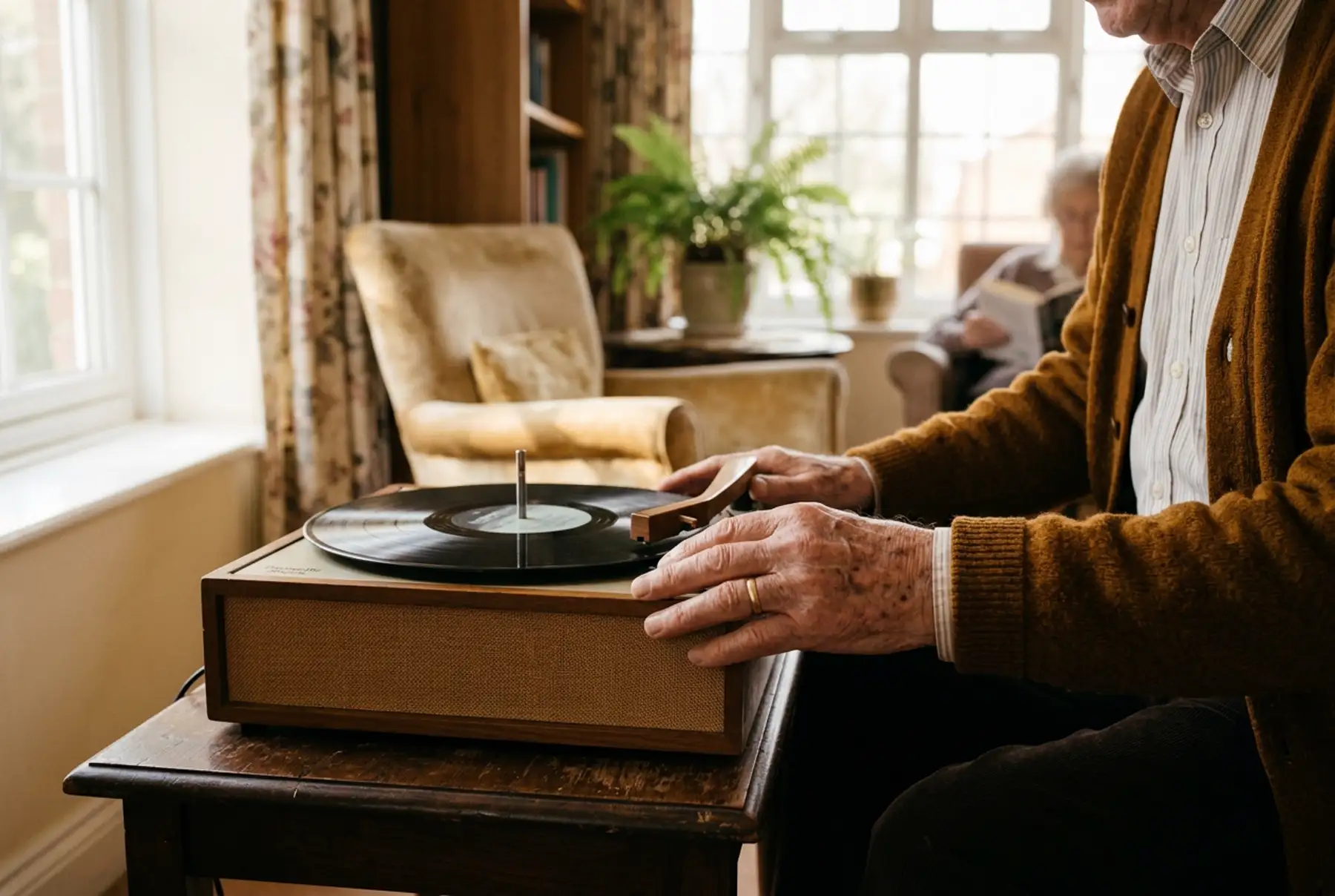
A reminiscence agent for memory care
The Songs He Still Knows.
Marisol has twenty minutes before the afternoon session with a new resident who barely speaks. Aftersong turns three remembered favourites into a card of music, film, food and places from the years he remembers best.
Built from the 55 and older audience alone, a list leans on the same famous names for everyone. Only 20 percent of what Aftersong puts on a card would be on such a list, built from Qloo results for the same 15 forms with no favourites, because it starts from what his family remembered.
01 The problem
Most care homes play one playlist for everyone.
57 million
people were living with dementia worldwide in 2021, with nearly 10 million new cases every year.
World Health Organization, Dementia fact sheet42%
annual turnover among certified nursing assistants in US nursing homes in 2025 (42.34 percent, down from 44.16 percent in 2024), across 917 homes.
AHCA, 2025-2026 Nursing Home Salary and Benefits Report summary, 9 September 202522 trials
of reminiscence therapy for dementia, with 1,972 people, were reviewed by Cochrane in 2018.
Woods, O'Philbin, Farrell, Spector and Orrell, Cochrane Database of Systematic Reviews, 2018, CD00112002 How it works
Four steps, one carer in the room.
01
The family names three favourites
Sam Cooke, Casablanca, his mother's jollof rice. They type it from anywhere through a private link.
02
Aftersong finds the years
People remember best what they lived between about ten and thirty. For a man born in 1940 that is 1950 to 1970.
03
Qloo links taste inside those years
Music, film, television, food and places, each tied to a favourite, each from his own window, not a generic oldies list.
04
The carer taps what she saw
Lit up, sang, no response, upset. Only her taps become memory, and the next card starts from what worked.
03 The card
What Marisol walks in with.
Loading the sample card
04 A plain AI, side by side
Same intake, same rules, two different lists.
A plain model is asked for items for the same resident. Every item is looked up in Qloo and checked: is it a real entity, is it inside his years, does Qloo link it to what he loved.
| Set | Aftersong | Plain AI passing | Outside the years | Not in Qloo | Personal items on the card |
|---|---|---|---|---|---|
| Curated forms | 15 of 15 cards built | 31.4% | 33.3% | 21.1% | 54.1% |
| Wild forms | 0 of 0 cards built | Not measured yet | Not measured yet | Not measured yet | Not measured yet |
05 What it will not do
Limits that are built in, not promised.
- It does not diagnose, and no line on a card claims a health effect.
- It does not add anything the model merely thinks he would like. Every item is a Qloo result inside his years.
- No resident name, note or health detail goes to Qloo. It receives entity IDs, tags, years and a place, plus the typed favourite or place name once, to confirm a match.
- It does not guess when Qloo has too little. The card says so and offers to widen the window.
- It does not remember what the carer did not see. Only her taps are memory, and they expire after 90 days unless repeated.
- It does not repeat something that upset him.
06 For care homes
Who it is for and what it might cost.
The user is the activities coordinator. The buyer is the director of care at a memory care operator or a home care agency. The pricing below is a hypothesis to test, not a result: about four dollars per resident per month, and free for a family with one resident. No customer has paid yet.